Juicy Interactive Visualization: Evaluating How Excessive Feedback Design Shapes Visualization Engagement
Shano Liang (Worcester Polytechnic Institute), Max Chen (Worcester Polytechnic Institute), Lane Harrison (Worcester Polytechnic Institute)

Presentation
- Session
- Please don't just stare at the picture
- Time
- - (US/Eastern) · session - Timezone
- Room
- America center
- Presenting from
- Boston
Links
Sign in to access the Paper PDF.
Sign in to access the supplemental material.
Supplemental Material: The original code of JuicyVIS prototypes can be found at https://github.com/revisit-games/juicyvis. The codes of deployed JuicyVIS online studies can be found at https://github.com/revisit-games/JuicyVIS-studies. The de-identified trial-level datasets for all three studies, SPSS analysis syntax used to reproduce the reported models, and corresponding output files can be found at https://osf.io/bs4cz/.
Abstract
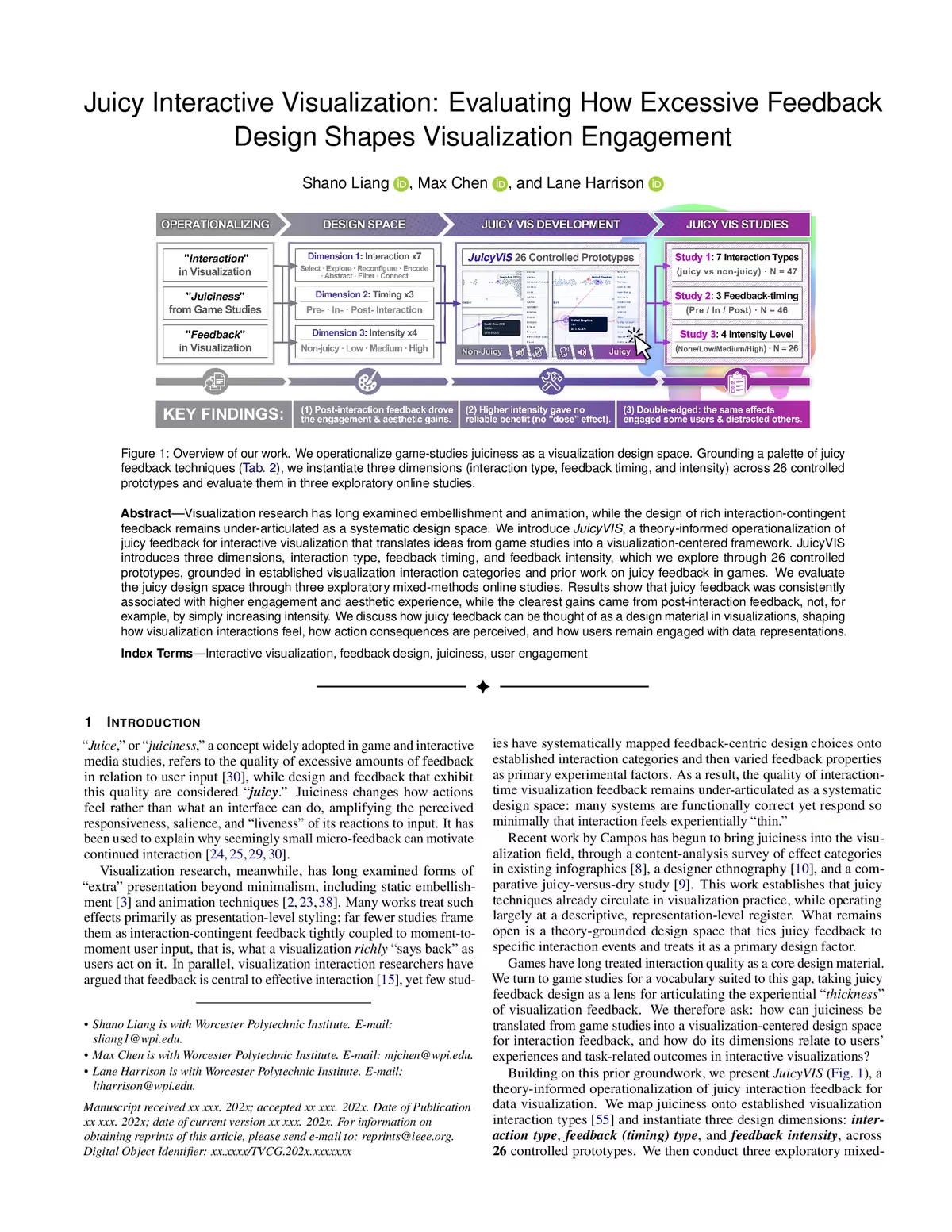
Visualization research has long examined embellishment and animation, while the design of rich interaction-contingent feedback remains under-articulated as a systematic design space. We introduce JuicyVIS, a theory-informed operationalization of juicy feedback for interactive visualization that translates ideas from game studies into a visualization-centered framework. JuicyVIS introduces three dimensions, interaction type, feedback timing, and feedback intensity, which we explore through 26 controlled prototypes, grounded in established visualization interaction categories and prior work on juicy feedback in games. We evaluate the juicy design space through three exploratory mixed-methods online studies. Results show that juicy feedback was consistently associated with higher engagement and aesthetic experience, while the clearest gains came from post-interaction feedback, not, for example, by simply increasing intensity. We discuss how juicy feedback can be thought of as a design material in visualizations, shaping how visualization interactions feel, how action consequences are perceived, and how users remain engaged with data representations.
For Practitioners
info/data visualization researchers, interactive media researchers, user experience researchers, game researchers, human-computer interaction researchers, UI researchers, etc.